Business model
A concept of the shopping centre as an integrated ecosystem was developed, together with a map of potential areas of value creation covering retail, services, logistics, technology, energy and the financing of change.
Case Study 02
Concept for rebuilding a shopping centre's business model — from the perspective of customers, tenants and financing institutions.
Leasing, online sales, logistics, technology, energy and tenant relations were combined into a concept of the shopping centre as an integrated business ecosystem — with new revenue streams, the potential to increase operational resilience and to improve the property's long-term risk profile.
A selected strategic experience underlying HEFT7. The project predates HEFT7. The founder took part in developing the concept, preparing the materials and building industry relationships in the role of Business Development Executive.
Key elements of the project
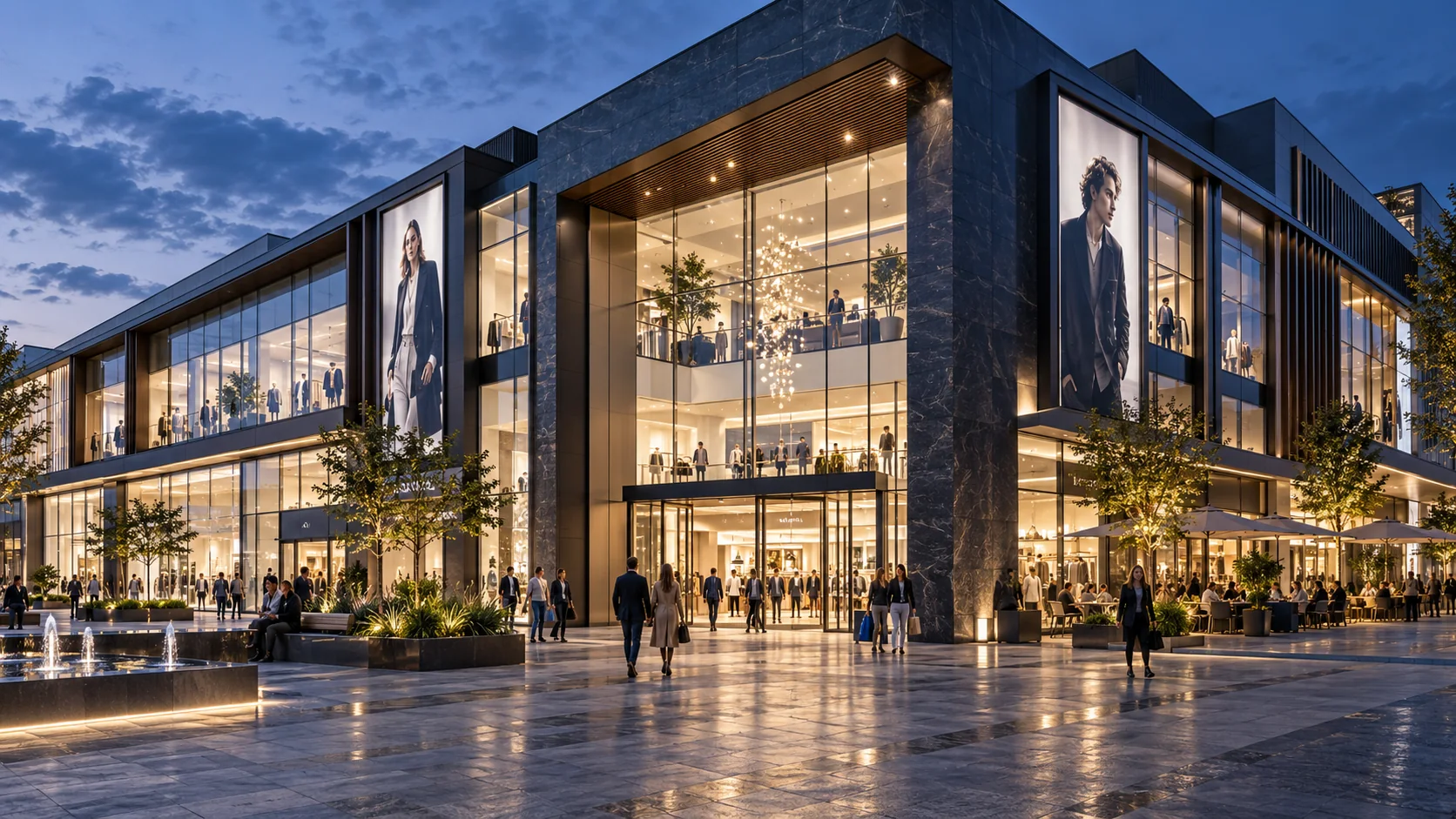
Conceptual illustration generated with AI. It does not show a site covered by an implementation.
01
The project was developed during a period of accelerated change in the operating conditions of shopping centres. The growth of online sales, changes in consumer behaviour and restrictions on bricks-and-mortar trade during the pandemic increased pressure on the traditional business model based primarily on leasing space.
The financing of shopping centres rests to a large extent on a property's ability to generate stable cash flows. Banks assess in this respect the structure and durability of rental income, operating costs, the quality of the tenant portfolio, the level of debt and the owner's ability to service its obligations on time.
A signed lease, however, is not the same as cash received. A tenant's ability to pay rent depends on the results of its business, its liquidity, its cost structure and its access to financing — both at the level of a single unit and of the whole company or group.
Tenants' difficulties can therefore pass on to property owners, and then to financing institutions. This mechanism became particularly visible during the pandemic, when restrictions on trading reduced footfall at centres and the revenues of some tenants, leading to rent renegotiations, restructurings of operations and, in some cases, insolvencies and the termination of leases.
The deterioration in tenants' condition increased the pressure on property owners' cash flows and, in some cases, on their ability to service debt. For financing institutions this meant higher credit risk and a potential need to increase expected credit loss provisions, depending on the assessment of individual exposures.
The situation also highlighted the importance of competencies going beyond standard lease management — in particular in restructuring relationships with tenants, limiting the risk of their insolvency and rebuilding a property's economic resilience.
Guiding idea
The project did not start with the question of what to do with empty space. It started with the question of how a shopping centre can create value more broadly than by providing square metres — and what conditions it would have to meet to strengthen its economic position and its credibility with financing institutions.
02
A shopping centre and its tenants form a linked business system, but their interests, sources of revenue and ways of responding to market change are not always aligned.
The traditional economic model of a shopping centre rests primarily on rental income, which leaves it heavily dependent on the condition of its tenants and the appeal of bricks-and-mortar retail. The growth of tenants' online sales does not automatically translate into growth in the property owner's revenue, even though the location, infrastructure and customer access of the site can also support multichannel sales.
At the same time a shopping centre has assets whose use can go beyond classic leasing: space, location, logistics facilities, technical infrastructure, access to energy and the ability to integrate services and data.
The traditional management model focuses mainly on commercialising space, handling leases and the day-to-day running of the property. It does not always include the active participation of the site's owner in developing tenants' sales models and improving their business performance.
Meanwhile, in the tenant–owner–bank relationship, tenants' operating difficulties can feed through to rental income, the level of vacancies, the costs of maintaining the site, its valuation and the owner's ability to service financing.
Renegotiating rents can ease short-term tensions, but in itself it does not answer the question of how to increase the economic value of the whole centre and build additional sources of revenue.
The mechanism is illustrative and does not present a measurement of the results of any specific property.
Guiding idea
"The value of a shopping centre also depends on the value it helps its tenants create."
03
The shopping centre was analysed from two complementary perspectives: that of the customer and tenant, and that of the equity owner and financing institution.
The first concerned the commercial attractiveness of the site, its competitiveness, its ability to attract customers and its potential to support tenants' sales.
The second focused on the economics of the property: the structure and stability of revenue, operating costs, the quality of the tenant portfolio, the level of risk and the ability to generate cash flows sufficient to service financial obligations.
The conceptual analysis covered the rent structure, potential sources of additional revenue, the use of space and logistics facilities, energy costs, technological possibilities and the integration of bricks-and-mortar retail with online sales.
We also examined the relationships between tenants' financial condition, the owner's income, the property's operating profitability and its credit profile.
A shopping centre's tenant base is not uniform. It includes individual retailers, chains managing their own stores, businesses operating within franchise systems and large strategic tenants, often acting as traffic generators.
The individual groups differ in business model, scale of operations, financing options, negotiating strength and lease terms.
Strategic tenants may benefit from preferential rent terms because of their importance for footfall and the attractiveness of the site. The economic justification for such terms should, however, be assessed in the context of the whole lease portfolio and each tenant's impact on the centre's revenues and costs.
Franchise structures add further complexity: the party to the lease may be the franchisee, the franchisor or another group entity. Depending on the structure adopted, the scope of financial and operational responsibility of each party may differ.
The properties themselves may also operate within larger investment portfolios and capital structures, which affects investment decisions and the way they are financed.
The project therefore had to take into account the interests of:
The diagnosis was sectoral and conceptual in nature. It was not a financial audit of a specific shopping centre.
Conclusion from the diagnosis
The economic value of a property does not depend solely on the number of signed leases, but on the quality and durability of the cash flows it generates, the level of costs, the risk structure and the ability to remain competitive in a changing environment.
04
The concept assumed transforming the shopping centre from a model focused primarily on leasing space into an integrated ecosystem of retail, services and infrastructure — able to develop additional revenue streams, optimise costs and strengthen the value offered to customers and tenants.
Integration of retail, services, logistics, infrastructure and relationships with customers and tenants within one business environment, in which the individual functions mutually support the site's development and economic efficiency.
Development of the mall-commerce concept as a shared multichannel sales environment, complemented by potential logistics and warehousing services, order handling and new ways of commercially using space.
The plan included analysing possible mechanisms for monetising services, including handling fees, commissions or subscription models, depending on tenants' needs and the economic justification.
Analysis of rent variants based on floor area, turnover or a mixed model, taking into account the differences between tenant groups and the scope of services provided by the site.
The aim was to link lease economics more closely with tenants' operations and the value created by the centre, without automatically passing on to the owner responsibility for their financial results.
Consideration of uses of digital infrastructure, data analytics and automation in property management, logistics services, customer traffic analysis, space efficiency and the integration of sales channels.
Technologies such as 5G, Edge Computing or advanced data analytics were treated as potential tools supporting specific operating functions and revenue models, not as an investment goal in their own right.
Analysis of the potential use of blockchain-based solutions in settlement processes, and of tokenisation as one of the mechanisms considered for structuring financing or rights related to the property.
The possibility of applying such solutions would require a separate assessment of their legal, regulatory, technological and economic feasibility.
Consideration of the use of renewable energy sources, consumption optimisation and solutions that increase the site's energy efficiency.
Assessing the potential benefits would have to take into account capital expenditure, the structure of energy consumption, technical installation options, the payback period and the settlement rules between the owner and tenants.
Development of conceptual assumptions for a recovery plan and for financing the changes, taking into account cash flow stability, the structure of revenues and costs, the level of debt and the risks associated with carrying out the investments.
It was assumed that improving the predictability of cash flows and the site's economic efficiency could have a positive effect on its credit profile, subject to confirming the profitability and feasibility of the proposed solutions.
Development of an approach to relationships with tenants experiencing financial difficulties, covering an assessment of their business situation, possible settlement options, renegotiation of the terms of cooperation and support in seeking restructuring solutions.
The aim was to limit the risk of losing tenants and revenue while taking into account the economic interests of the property owner.
05
A concept of the shopping centre as an integrated ecosystem was developed, together with a map of potential areas of value creation covering retail, services, logistics, technology, energy and the financing of change.
Tenant groups were analysed conceptually, together with the differences in their business models, terms of cooperation and structures of contractual responsibility, taking into account the interests of site owners and managers.
Assumptions were developed for integrating tenants' offers with online sales and local customer service, together with preliminary directions for monetising additional services.
The use of selected areas and facilities of the site for warehousing, order fulfilment and logistics functions was considered.
Variants of the rent structure were analysed, covering rates per area, a share of turnover and mixed solutions.
Potential uses of digital infrastructure, data analytics, automation and blockchain- and tokenisation-based solutions were identified. No implementations or technical validation of these solutions were carried out.
Energy efficiency, renewable energy sources and cost optimisation were considered as potential elements for improving the site's economics.
Conceptual assumptions for a recovery plan were developed, together with directions for assessing the financing of changes from the perspective of cash flow stability and credit risk.
A concept was prepared for supporting owners and managers in working with tenants in a difficult economic situation, in particular in restructuring processes.
A working division of the solutions into stages was prepared, together with conceptual and presentation materials and a proposal for further verification of the assumptions at a selected site.
06
The project produced a strategic concept of a new operating model for a shopping centre, covering the related areas of retail, leasing, logistics, technology, energy and the financing of change.
The model was designed in a modular layout, allowing individual solutions to be considered both as elements of a larger transformation and as potential stand-alone initiatives.
Assumptions were also prepared for managing relationships with tenants in financial difficulty, together with a working division of further work into stages.
The concept was consulted with representatives of the advisory, banking and research sectors. The consultations formed part of the project's development and did not mean formal approval of the model or confirmation of its effectiveness.
Continuing the work was proposed through an analysis and pilot at a selected site, allowing the economic, operational and technological assumptions to be verified in real conditions.
The project ended at the conceptual stage. A pilot and operational implementation were not carried out.
07
The outcome of the work was a structured strategic concept and materials enabling further assessment and development of the proposed model.
The following were produced:
These are confirmed results of conceptual work, not implementation results. The project did not deliver measurements of revenue growth, cost reduction, improved occupancy or growth in property value.
08
The project did not include operational implementation of the proposed model or a pilot at a specific property.
Verifying economic and operational feasibility would require a detailed analysis of a selected site, covering the actual structure of revenues and costs, the tenant portfolio, space availability, demand potential, capital expenditure and organisational and technological capabilities.
Only on that basis would it be possible to prepare a full business case and to define implementation responsibilities, the schedule, performance measures and financing conditions.
The case study documents the development of a strategic concept and directions for transformation. It does not present them as an implemented model or as confirmed financial effects.
09
The future model of a shopping centre is worth assessing at the same time from the perspective of the customer, the tenant, the property owner and the financing institution.
A signed lease is not yet a realised cash flow, and a site's attractiveness does not derive solely from the amount of space available.
Developing additional sources of revenue, optimising costs, integrating sales channels and actively managing tenant risk can increase a property's economic resilience and create a basis for improving its long-term competitiveness.
This does not, however, mean an automatic increase in the site's value or an improvement in its credit profile. The real effects depend on the profitability of the proposed solutions, the stability of cash flows, the level of risk and the organisation's ability to implement them.
The project made it possible to organise the links between the retail model, tenants' operations, the economics of the property and its financing. It also indicated which assumptions would have to be verified before investment decisions are taken.
Management takeaway
"A new business model needs not only an idea of value, but also the conditions in which that value can be tested."
10
11
The summary shows the actual scope of the conceptual work and indicates the stages that would require separate implementation engagement.
Sectoral analysis of how shopping centres operate, of economic dependencies, the structure of interests and potential directions of development. No financial audit of a specific site.
Development of a direction for transforming the shopping centre into an integrated ecosystem, and of assumptions for broadening the functions and sources of value creation.
Preparation of a modular concept covering leasing, multichannel retail, logistics, technology, energy, financing of change and tenant risk management.
Conceptual and presentation materials, preliminary phasing and a pilot proposal. No complete implementation plan and no full feasibility analysis for a specific property.
A pilot and operational implementation were not carried out as part of the project.
The operational and financial effects of the proposed model were not measured.
Developing the target operating mechanisms, processes, accountabilities and tools for sustaining results would require further stages of design and implementation.
If a property's existing business model limits its potential, it is worth starting with an assessment of the revenue structure, the condition of tenants, operating costs and the possibilities for creating new sources of value.
HEFT7 helps identify directions for transformation, organise strategic options, assess their business justification and define the conditions for moving from concept to delivery.